

The Question
What would it take to get Americans into farm work? And why don’t we do that already? Americans aren’t usually people afraid of hard work. We’re a nation built by coal miners, steel workers, cowboys, and homesteaders. But we have gone a little softer in the last century. Or have the jobs gotten worse?”
A Look Back at 1965
NPR recently ran a story about the summer of 1965, in which American high school jocks worked — or tried to work — as farm laborers.
Work started before dawn. “The wind is in your hair, and you don’t think it’s bad,” Carter recalls. “Then you go out in the field, and the first ray of sun comes over the horizon. The first ray. Everyone looked at each other, and said, ‘What did we do?’ The thermometer went up like in a Bugs Bunny cartoon. By 9 a.m., it was 110 degrees.”
Garden gloves that farmers gave the students “lasted only four hours, because the cantaloupe’s fine hairs made grabbing them feel like picking up sandpaper.”
The University High crew “worked six days a week, with Sundays off, and they were not allowed to return home during their stint. The farmers sheltered them in ‘any kind of defunct housing,’ according to Carter — old Army barracks, rooms made from discarded wood, and even buildings used to intern Japanese-Americans during World War II.”
The Brutality of Farm Labor
“I’ve never done work that physically hard. I’m certain I would collapse from heat exhaustion before noon. (In fact, heat-related deaths occur 35 times more often in agricultural work than in other industries.) Yet many workers do it day after day, every harvest, every year.”
That leads to the question: What would it take to get US citizens to do these jobs? Why don’t we do that?
Also Read: Intensive Blood Pressure Control Linked to Lower Risk of Heart Attack and Stroke
What American Workers Expect
“Assuming I could build up the physical stamina to do the work, what would it take for me to do it for pay? I would definitely want better protection from both the sun and the crops. Rolling shade tents, sturdy gloves, frequent breaks, plenty of Gatorade, knee pads… all of that and probably shorter working days.”
“And would I do it for minimum wage? Not the federal $7.25 an hour, that’s for sure. That would barely cover all the extra food I would need to work that hard.”
What Migrant Workers Get
“Needless to say, farm workers don’t get all that. We know that most agricultural laborers are migrants (documented or not), and we have photographic evidence that they’re not getting shade and fans. If they rely on farm-provided shelter, it’s not a four-star hotel — it might not even be air conditioned.”
“For the undocumented worker, the situation can be worse. Because they could be reported and deported, they often fear to speak up against poor conditions, mistreatment, illegally low wages, or straight-up wage theft.”
So why do they subject themselves to this work? NPR quoted a Detroit Free Press editorial from the 1960s: “Dealing with crops which grow close to the ground requires a good deal stronger motive than money or the prospects of a good workout… Like, for instance, gnawing hunger.”
Business and Cheap Labor
“All businesses want to reduce their costs, and labor — i.e., the cost of hiring workers — is one of those.”
“Farm workers in some cases are allowed to be paid piece rate, which can be lower than minimum wage. Farms that qualify as ‘small’ are exempt from paying agricultural workers minimum wage and can employ minors if their parents are also employed.”
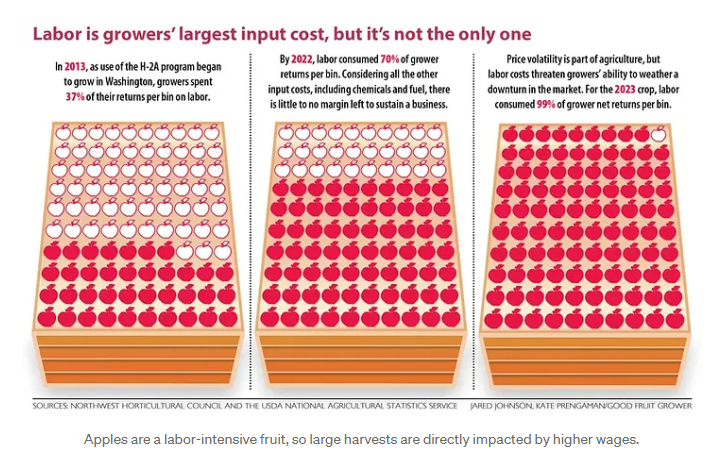
Although uneven across farms, “the US farm sector is expected to grow profits by $30B in 2025. Clearly there is money around. Having to pay workers a higher wage is not itself the problem! It’s only a problem if farmers are unable to sell their produce for enough money to afford the wages.”
Cheap Food, Hidden Costs
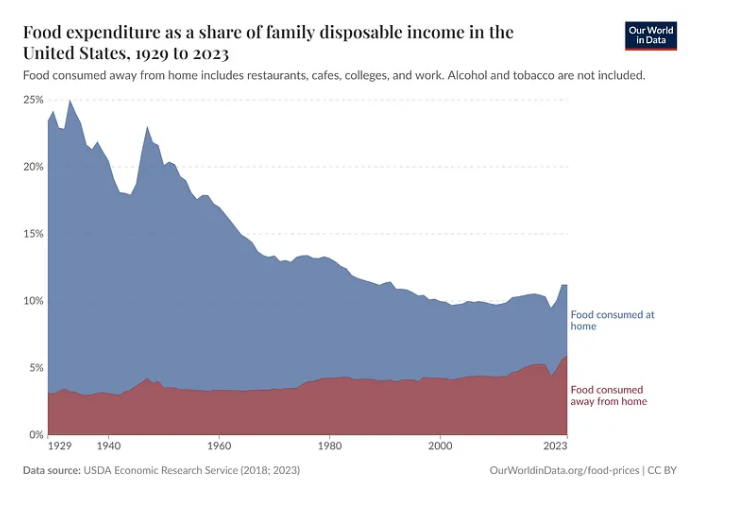
“Most Americans, myself included, are far removed from any experience of how our produce gets from the field to the grocery store. Agricultural workers are ‘out of sight, out of mind,’ and we have no reason to complain, because food is cheaper now than it has ever been in history.”
“In 1901, the average household spent 40% of their budget on food. Until the 1950s, it was usually more than 20%. Only since the 1990s has food averaged less than 10% of a household’s disposable income.”
“Yes, average spending on food as a percentage of income is the highest it’s been since 1991. The overall average hides the reality that food spending varies widely by income, with the lowest-income households regularly spending 20–30% of their after-tax income on food. Still, most of us have gotten used to spending 15% or less of our income on food.”
Protest and Pressure
“If shoppers are ignorant or willing to turn a blind eye to shoddy worker treatment, farms will keep taking advantage of people.”
“Laborers and unions fought for minimum wage, workplace safety, and regulators like OSHA. What the government requires, companies don’t have to justify to shareholders.”
Protest works. “Around the time I was at the University of Michigan, many students were protesting Michigan’s contract with Nike for sports uniforms and apparel because of Nike’s use of sweatshops… The people who can afford to need to be loud on behalf of those who can’t.”
The Real Cost of Food
“But asking farms to pay workers more really would make food cost more. That would hurt lower-income families the most, right when the law is already less keen on helping others to pay for food and healthcare.”
“Protecting agricultural workers is the right thing to do, but we have to recognize the consequences and take those into account. Any action for farm workers’ rights and wages should therefore include advocating for better food security programs and poverty reduction.”
“We’ll know we’ve succeeded if Americans are willing to take the job and can still buy vegetables.